Reprinted from the Marin IJ Voice op-ed column on 9/11/26
I’ve lost count of how many times San Rafael officials have asked voters for “just one more tax” to protect essential services.
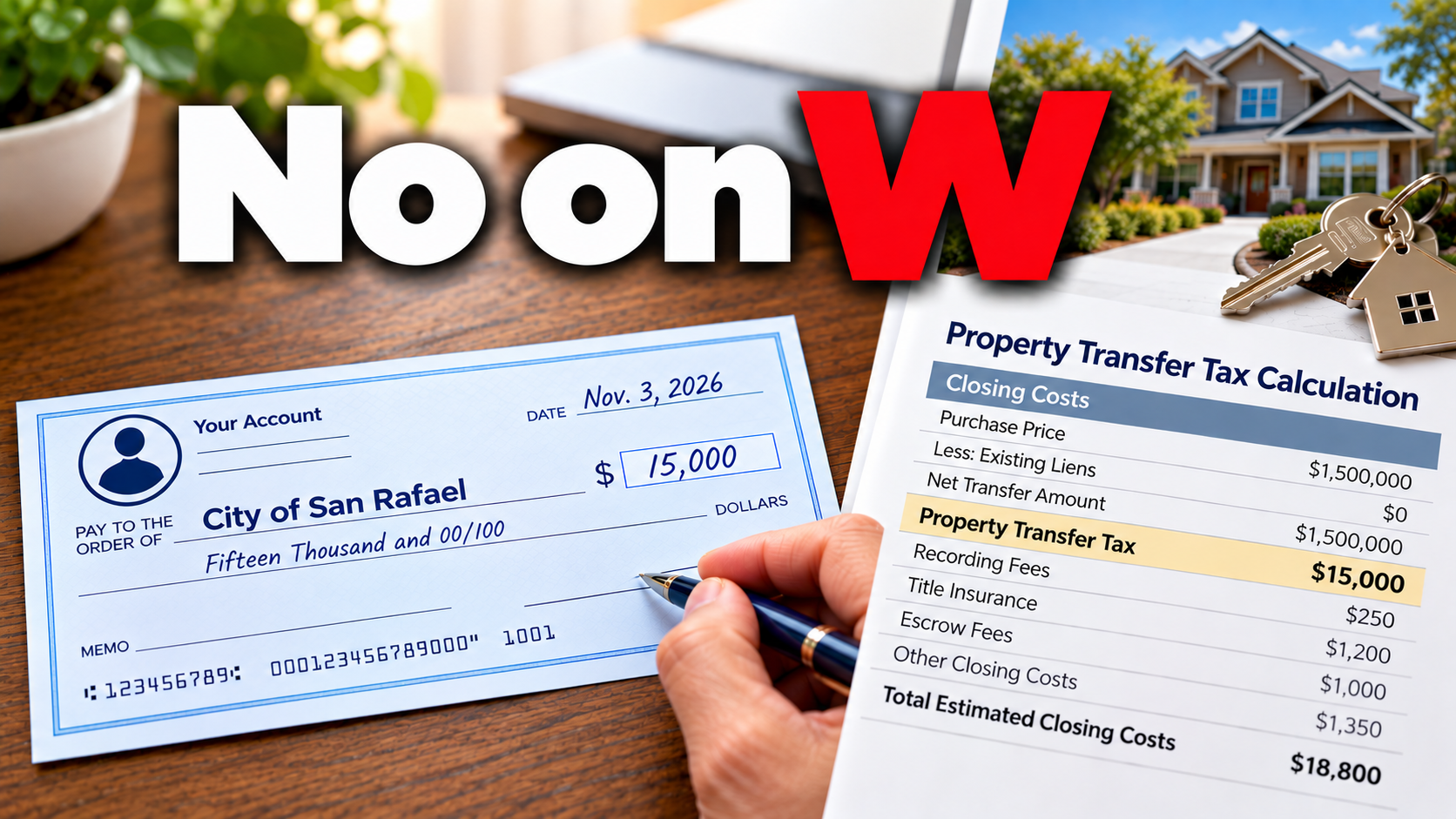
Measure W on the November ballot is the latest, and it’s not a small tax: It would increase the city’s real property transfer tax from 0.2% to 1% — a fivefold jump — on every home and business that changes hands. Before voting, it’s worth asking why the city keeps needing more, and whether this particular request holds up.
Start with the 400% increase. On a $1 million home sale, the city’s cut goes from $2,000 to $10,000. Buyers likely end up paying for all or part of the tax, thereby increasing their closing costs or monthly mortgage expense. Landlords who buy or refinance a rental building pass the added cost through to tenants as higher rent. And to the extent to which a seller bears part of the tax payment, it reduces proceeds available for the next home or eldercare.
Ironically, a transfer tax this steep can work against the city’s own finances. When selling gets more expensive, fewer people sell. Seniors who might have downsized or moved closer to family stay put, because the tax makes the math worse. Under Proposition 13, homes get upwardly reassessed to full market value only when they change hands.
So every sale that Measure W discourages results in the loss of the extra revenue that would have come from a newly increased valuation. Buyers squeezed by a bigger closing cost might disappear, perhaps electing instead to buy in Larkspur or San Anselmo, towns with no city transfer tax at all.
Without a sale, San Rafael loses the transfer tax, the future tax-base increase and whatever that household would’ve spent locally. Businesses incurring a higher cost might locate elsewhere.
City officials point to a possible $2 million deficit a few years out, in 2030, as the reason for this tax. But Measure W is projected to bring in about $6 million a year on top of what the current tax already raises. It’s three times the size of the shortfall it’s supposed to fix. And it never expires. There’s no sunset clause, no built-in check-in with voters, nothing that requires the city to scale it back if the budget picture improves or residents’ ability to pay worsens.
That permanence matters more than it might seem, because Measure W is a general tax. It can be spent on anything. The money lands in the general fund. Nothing in the law requires it be spent on the fire response, street repairs or homelessness programs named in the ballot question. Supporters point to a tax oversight committee as reassurance, but that committee only reviews spending after it happens — it has no power to direct or limit it beforehand. We’ve heard this same “trust us, there’s oversight” pitch before, attached to earlier tax measures. That hasn’t kept city officials from coming back for more.
San Rafael has come back repeatedly. Counting Measure W, San Rafael has approved nine new or increased city tax measures in roughly 20 years — sales taxes, a cannabis tax, a construction tax, a paramedic tax and library taxes. Measure W would be the fifth of these general taxes that can be spent on anything. They would all be in place simultaneously. All are justified the same way: They are protecting essential services.
At some point that pattern stops looking like a series of critical fixes and starts looking like a habit.
To be sure, the city’s needs aren’t made up. Streets need fixing, paramedic response times matter, and the SAFE Team does real work with people in crisis. But needing money and needing this particular tax — at this size, forever, with no restrictions — are two different things. San Rafael hasn’t made the case for Measure W.
A responsible government asks for what it actually needs and shows the math. It doesn’t demand three times the shortfall while selling it as a modest increase and sugarcoating it with “oversight.” Before San Rafael officials get another blank check, we deserve to see a financial plan that fits within what we already pay.
Kingston Cole, of San Rafael, is vice president for the Coalition of Sensible Taxpayers, a Marin-based nonprofit civic-engagement organization.